
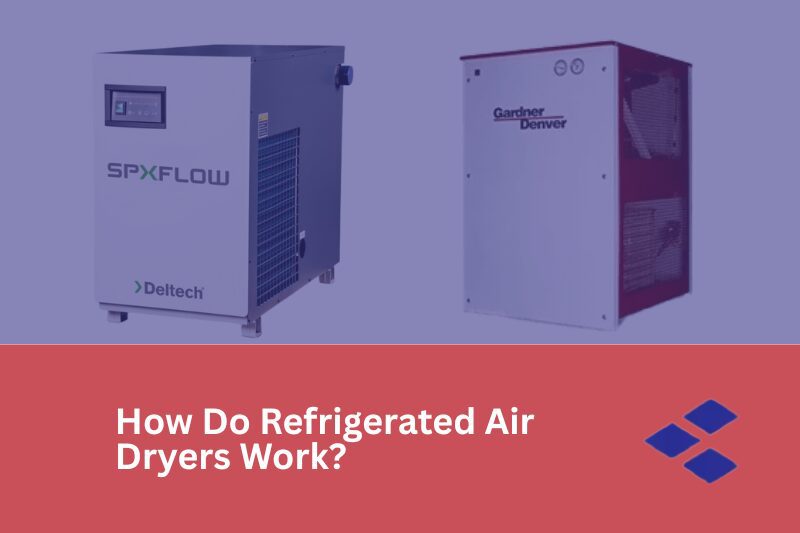
Compressed air systems are critical in many industrial settings, but the air they produce often contains water vapor. When that vapor condenses, it can cause corrosion, clog filters, damage pneumatic tools, and lower product quality. Refrigerated air dryers prevent these problems by removing moisture from compressed air before it reaches downstream equipment—ensuring clean, dry, and reliable air delivery.
Among the different types of air dryers available, refrigerated air dryers are the most common for general industrial use. They’re reliable, cost-effective, and efficient for applications that don’t require extremely low dew points.
The Basic Principle
Refrigerated air dryers work by cooling compressed air to a temperature where moisture naturally condenses into liquid form, which can then be removed from the system. It’s the same process that causes condensation on a cold beverage on a humid day—when warm, moisture-filled air hits a cold surface, water droplets form.
In essence, these dryers use refrigeration technology similar to what’s found in air conditioners or refrigerators, but applied to compressed air systems.
Step-by-Step: How Refrigerated Air Dryers Work
Here’s a simplified breakdown of the process:
- Warm, Moist Air Enters the Dryer
Compressed air from the compressor is hot and filled with water vapor. This air first passes through a pre-cooler, where it begins to lose some of its heat. - Air Passes Through the Evaporator
Inside the dryer, a refrigeration circuit cools the air to around 35–40°F (1.5–4.5°C). As the air cools, moisture condenses into liquid water droplets. - Moisture Is Separated and Drained
The condensed water collects in a moisture separator, typically paired with an automatic drain system that removes the liquid without disrupting air flow. - Reheated for Delivery
The now-dry, cold air passes back through a heat exchanger, where it’s warmed slightly using the incoming hot, moist air. This reheating prevents condensation from forming on downstream pipes. - Dry, Conditioned Air Exits the System
The final product is clean, dry air that’s safe for tools, instruments, and other sensitive equipment.
This cycle runs continuously, maintaining a consistent dew point and ensuring reliable operation across a range of ambient conditions.
Types of Refrigerated Air Dryers
Refrigerated air dryers generally fall into two main categories:
- Non-Cycling Dryers:
The refrigeration system runs continuously, keeping the evaporator cold at all times. These dryers are simple and ideal for applications with a steady air demand. - Cycling Dryers:
These systems use controls that turn the refrigeration compressor on and off as needed, depending on air demand. This design saves energy when the system is operating at partial load.
Some advanced models feature variable-speed drives, offering even greater energy efficiency and temperature control.
Benefits of Using a Refrigerated Air Dryer
- Prevents Corrosion: Removing moisture protects metal pipes, valves, and pneumatic tools from rust and degradation.
- Improves Product Quality: Ensures clean air for applications like painting, packaging, and assembly lines.
- Extends Equipment Life: Keeps downstream machinery functioning at peak efficiency.
- Reduces Maintenance Costs: By keeping air dry and clean, filters and components require less frequent replacement.
- Energy Efficiency: Modern refrigerated dryers offer smart control systems to optimize power usage.
Common Applications
Refrigerated air dryers are used across a wide range of industries, including:
- Manufacturing: For powering pneumatic tools and maintaining consistent production quality.
- Food & Beverage: To ensure sanitary, moisture-free compressed air in processing and packaging.
- Automotive: For painting, finishing, and assembly operations.
- Pharmaceuticals: To maintain clean, dry conditions that meet regulatory standards.
Essentially, any operation that relies on compressed air can benefit from integrating a refrigerated dryer into its system.
Maintaining Your Refrigerated Air Dryer
Like all mechanical equipment, refrigerated air dryers require routine maintenance to operate efficiently. Key tasks include:
- Regularly cleaning the condenser coils to maintain cooling efficiency.
- Checking and replacing air filters as needed.
- Draining condensate traps and separators.
- Verifying refrigerant levels and inspecting for leaks.
- Monitoring dew point readings for consistent performance.
Scheduled preventive maintenance can significantly extend your dryer’s life and improve air quality throughout your facility.
Partner with ESA for Reliable Air System Performance
At Engineering Sales Associates (ESA), we understand how critical clean, dry air is to your industrial operations. Our experienced technicians can help you select, install, and maintain the right refrigerated air dryer for your system—confirming long-term performance and reliability.
Whether you need expert advice, a system evaluation, or 24/7 service support, ESA has you covered. Contact us today to learn how we can help protect your equipment, optimize energy efficiency, and keep your operations running smoothly.