
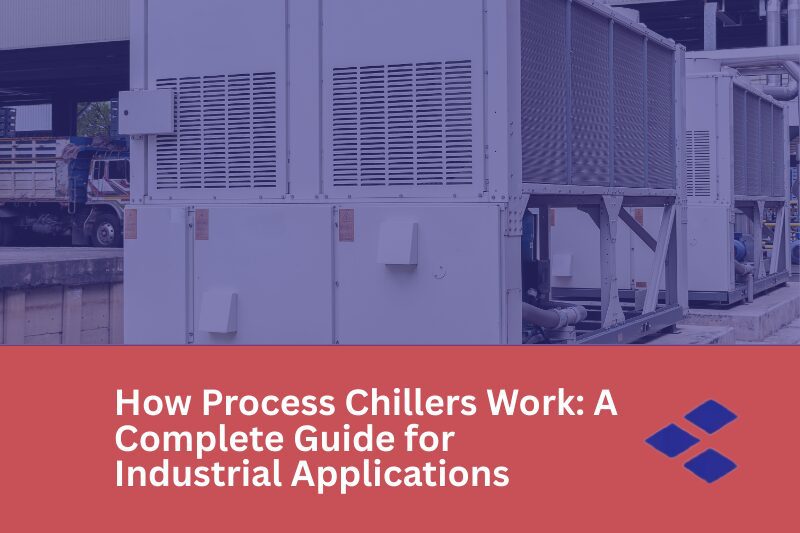
In many industrial environments, managing heat is far from being considered optional; rather, it’s critical. From manufacturing lines to medical equipment to food and beverage production, excessive heat can damage machinery, compromise product quality, and bring entire operations to a halt. That’s where process chillers come in.
Process chillers are engineered to remove heat from industrial processes and maintain precise temperature control, ensuring equipment operates safely, efficiently, and consistently. But how exactly do they work? And what makes them essential to so many applications?
Let’s take a closer look at the inner workings of process chillers and why they’ve become an indispensable part of modern industrial systems.
What Is a Process Chiller?
A process chiller is a specialized cooling system designed to remove heat from equipment, fluids, or air used in an industrial process. Unlike HVAC chillers, which control building comfort temperatures, process chillers provide tight, consistent cooling that supports manufacturing, processing, and laboratory environments.
Their primary purpose is simple: Absorb heat from a process and discharge it somewhere else.
By controlling heat, process chillers prevent equipment failure, stabilize production outputs, improve efficiency, and extend the lifespan of critical components.
The Four Main Components of a Process Chiller
Process chillers operate using a closed-loop refrigeration cycle involving four essential parts:
- Evaporator
This is where the cooling magic begins. The evaporator receives warmed process fluid and absorbs heat from it. Inside, a refrigerant evaporates as it absorbs thermal energy, turning from a liquid into a gas.
- Compressor
Once the refrigerant becomes a gas, the compressor increases its pressure and temperature. This prepares the refrigerant for the next stage: heat removal.
- Condenser
In the condenser, heat is expelled into the surrounding environment—typically through air or water. As the refrigerant loses heat, it condenses back into a liquid.
Common types of condensers include:
- Air-cooled condensers, which use ambient air
- Water-cooled condensers, which rely on a cooling tower or water loop
- Expansion Valve
Before returning to the evaporator, the refrigerant flows through an expansion valve, which lowers its pressure and temperature. The chilled refrigerant can now absorb heat again, continuing the cycle.
This continuous loop keeps process fluids—even under heavy industrial loads—at the precise temperature required.
A Step-by-Step Look at the Cooling Cycle
To better understand how a process chiller works, here’s a simplified breakdown of the refrigeration cycle in action:
- Warm process fluid enters the evaporator.
The fluid transfers its heat to the refrigerant. - Refrigerant absorbs heat and vaporizes.
It transitions from liquid to gas as the process fluid cools. - Gas refrigerant moves to the compressor.
Pressure and temperature rise significantly. - Hot, high-pressure refrigerant enters the condenser.
The condenser removes heat, returning the refrigerant to a liquid state. - Liquid refrigerant passes through the expansion valve.
Pressure drops, lowering its temperature. - Cycle repeats as chilled refrigerant returns to the evaporator.
This highly efficient system can maintain precise temperatures even under fluctuating workloads, which is crucial for applications that rely on continuous uptime.
Common Industrial Uses for Process Chillers
Process chillers are found across nearly every industrial sector. Their ability to maintain accuracy and consistency makes them invaluable in applications such as:
- Plastics manufacturing (cooling molds and hydraulic systems)
- Beverage and food processing
- Pharmaceutical production
- Laser cutting equipment
- CNC machinery
- Medical imaging systems (like MRI machines)
- Chemical processing
- Breweries and distilleries
Any process that generates heat, and requires precise temperature control, benefits from a properly sized and maintained process chiller.
Why Process Chillers Are Essential
The advantages of integrating a process chiller into your operation include:
Reliable Temperature Control
Precision cooling ensures consistent product quality and predictable equipment behavior.
Increased Equipment Lifespan
Proper temperature management reduces wear, overheating, and premature component failure.
Energy Efficiency
Modern chillers use variable-speed compressors, intelligent controls, and high-efficiency refrigerants to optimize performance.
Reduced Downtime
By preventing overheating-related failures, chillers support uninterrupted production.
Lower Operational Costs
Efficient chillers reduce energy consumption, maintenance needs, and emergency repair costs.
Maintaining a Process Chiller for Peak Performance
Routine maintenance is critical to ensuring long-term reliability. At a minimum, facilities should:
- Inspect and clean condenser coils
- Check refrigerant levels and look for leaks
- Monitor fluid quality and change it as needed
- Replace filters regularly
- Verify pump performance and flow rates
- Review alarms, sensors, and system controls
Lack of maintenance is one of the most common causes of chiller inefficiency and failure—and one of the easiest to avoid.
Protect Your Cooling System with ESA
At Engineering Sales Associates, our technicians have decades of experience servicing, installing, and optimizing process chillers for industrial operations. Whether you need a new chiller, routine maintenance, emergency service, or expert troubleshooting, ESA is here to support your operation 24/7.
Ready to improve efficiency and protect your equipment? Contact ESA today for a consultation and expert support for all your process chiller needs.